Showing posts with label WWII. Show all posts

Wednesday, 1 February 2012

The Buddha in the Attic: Review


The Buddha in the Attic
By Julie Otsuka
Published in 2011
Published by Alfred A. Knopf
ISBN: 978-0-307-70046-9

I purchased this book myself for the purposes of book club. 

What possesses someone to pack up everything they own and move to a country they have never been to before, especially when they don't speak very much of the language nor understand very much of the culture of their destination country? Necessity? A dream of a better life? Wanderlust? Love? For the group of young Japanese women in this novel it was a bit of everything. They were to be married to men who they had only heard about through written letters and a single photograph. Leaving their lives, their families, their culture and their comfort zone, they set out across the ocean for America. When they arrived the reality that faced them was devastatingly different to their hopes and expectations.

Through first person plural narration, Otsuka presents the collective experiences of these women, divided thematically by significant events – from their first night as wives to childbirth to their removal from the towns and cities along the Pacific coast during World War Two. As a result of this narrative style and thematic organization there isn't a traditional plot with a beginning middle and an end. Rather the experience of reading the stories of many comes to be almost like a meditation on lives past. The choice to present this material in this way is a wise one, I think, as to do anything other than present the simple facts could create a potential emotional overload for the reader. This is not only because of the number of different perspectives and stories but also because of the confronting nature of the content within.

I remember very clearly the first time I discovered that Japanese Americans and Canadians had been removed from their homes and livelihoods during the Second World War when I read Obasan by Joy Kogawa for a postgraduate trauma literature paper. I'd had no idea that this kind of thing had happened and to be honest, I was shocked by what I learned. It hadn't mattered if these people had lived there half of their lives, or if they had been born there and were therefore citizens – in the wake of the Japanese attack on Pearl Harbor President Roosevelt authorized the exclusion of all people of Japanese ancestry from the Pacific coastline and housed them in war interment camps inland. Like I said – it's confronting stuff. But let's forget for a moment all of the why's and the wherefores of this decision. Let's hold off on the pointing of fingers and the placement of blame and guilt and focus on what it is that Otsuka is telling us to do – to listen to the voices that couldn't be heard back then.

These voices are not only of the Japanese who were interred but also of their neighbors who were very much affected by their removal. The last chapter is written from the perspective of these neighbors which shows that at first they were worried, upset and guilty about the way the Japanese had been treated. But as time passes and new stores open in place of Mr. Harada's grocery or the Imanashi Transfer, and the Instructions to All Persons of Japanese Ancestry notices fade and blow away with a stronger breeze than usual, so too do the feelings and the memories. People move on. It seems cold but it is after all, human nature to let go of things that do not continue to affect you on a daily basis. Especially when your country is about to become involved in the worst war this world has ever seen.

Otsuka's novella is an attempt to reestablish these lost stories and assure their place within the narrative of America's history. As the title suggests, it is time for it to be taken down out of the attic, dusted off and examined, honestly and with an open heart and mind. As with many novels that deal with subjects of uncomfortable moments in history this is not an uplifting read. It presents us, the present day reader, with a slice of a time gone by told through the imagined voices of those who experienced it. It's a tale of belonging, of inner strength, of cultural struggles and of real life. It's a timely reminder of how far we have come in this world, but also, perhaps, how much further we have yet to go.

Thursday, 13 January 2011

Sarah's Key: Review

Sarah's Key
By Tatiana de Rosnay
Published in 2007
Published by St. Martin's Press (1st ed)
ISBN: 978-0312370831 


I read this book as part of my book club and I was not paid for this review. 


Dark days. Every country has at least one of these in its history, some have many more. This novel is about one of France's less shining moments, when French Police rounded up hundreds of Jewish men, women and children and kept them in inhumane conditions in the Velodrome d'Hiver before being shipped off to their deaths in Auschwitz. Some Parisians tried to help them, most turned a blind eye. 


The story has two intertwining narratives. Sarah, the girl of the title, locks her brother in a concealed closet when the police come knocking on her family's door, thinking that she will be able to return and rescue him. Julia, an American journalist who has lived in Paris for most of her life is asked to write a story about the Roundup for its sixtieth anniversary. She finds the story captivating and quickly becomes personally involved in her research, particularly when she discovers that her husband's family's and Sarah's histories overlap. 


It's a very interesting premise but I just couldn't lose myself in this book. I found that the characterisation of Sarah was a little heavy handed and felt that she had been created more for the purpose of being the vehicle or the author's musings on 'how could the French Police have done such a thing' rather than being a real imagining of a 10 year old girl being wrenched from all that she knew and losing everyone she loved. Additionally, the relationship between Julia and her over-sterotyped French husband (snide, xenophobic and philandering but makes it up to her with amazing sex - oh come on) didn't ring true for me either. 


Another issue I had was the ending. I don't want to give too much away or those who haven't read it yet but I just have to say that I didn't believe the ending. I don't think that Sarah would have done that and I certainly didn't believe the implied romance between the two characters at the end. It fell flat and let the last gasp of air out of a book that could have been really good. 


That said, my rating of this book was 2.5/5 at our book club but other people really loved it and gave it 4/5. To it's credit, it taught me something I didn't already know and I liked the descriptions of Paris. It's not a bad book, it just didn't move me the way I wish it had. 


Has anyone else read this book? If you have, were you surprised to find out about the round up?


Other reviews of this book: 
The Literary Amnesiac
The Avid Reader's Musings

Saturday, 9 October 2010

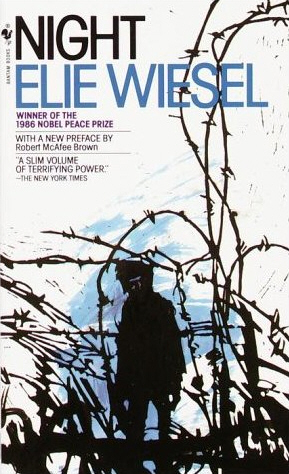
Night by Ellie Wiesel: Review

Night is the kind of book that blows your socks off whilst simultaneously giving you the feeling of being overwhelmingly grateful for having any socks at all. It is a sparse 100 pages that shakes you to the very core. 100 pages of one boy's account of being ripped from a normal life and thrown into the nightmare of concentration camps in Nazi Germany. It is, in my opinion, a must-read. These things, however uncomfortable, cannot be forgotten just as as other atrocities being perpetrated throughout the world as we speak should not be ignored.

One thing that really stood out for me in this novel was the feeling of disbelief and denial of reality that so many of the Jewish people felt throughout the whole experience. When they were moved into the ghettos and stripped of their homes, they thought this was the worst that could happen. When they were rounded up and put on cattle trains, they thought that perhaps a better place awaited them at the end. The harrowing scene where the seemingly hysterical woman who proclaims to see fire in the train carriages (later proving to be a chillingly accurate prophecy of the chimneys at the camps ahead of them) is violently silenced by those around her only serves to highlight the unreality of the situation and the inability of anyone to truly comprehend what was happening.

How could they? How could any person possibly take in and process this kind of treatment? I tried putting myself into their shoes and found myself frozen, overtaken by the helplessness of it all. All that was left for them to do was survive, to try and get through to the other side alive.

This is not an uplifting book. There is no Hollywood ending, no light relief. It is horror after horror and then more horror. You cannot, at any point, become immune to it. You are made to sit in the sun without water with them, you are crammed into claustrophobic cattle carriages with them, you are dragged through mud and starved with them. Reading Ellie Wiesel's vivid and uncompromising narrative is the closest any of us will ever come to understanding the Holocaust from a survivor's perspective. It's not a pretty ride, but it is one that opens your mind and makes you realise - at no point can any of us become complacent. Never should we take for granted a warm bed and a good meal. At the end of this book, I settled down for the night and I swear that my bed had never felt so comfortable.

Read this book. Read it for those who survived, read it for those who did not survive and read it for those who suffer other cruelties around the world. Only when our eyes and minds are open can the world become a better place.

Wednesday, 30 December 2009

auf Wiedersehen: Review

auf Wiedersehen
By Christa Holder Ocker
Published by Plain View Press
Published in 2009
ISBN: 978-1-935514-27-5

This book was sent to me by a publicist for review. I was not paid for this review.


Lately, I've been having something of a World War II binge. I watched Band of Brothers from start to finish while concurrently being enthralled by the National Geographic documentary Apocalypse: World War Two. Then auf Wiedersehen landed on my doorstep. It was, as it turns out, the perfect complement to my self education in the horror of previous generations. Not only is it a memoir, it is a memoir of a young German girl and the impact that the war had on her and her family, a vice we don't often hear from. The story picks up in the final scenes of World War Two - the Russians are closing in from the East, the Americans and the British approaching from the West. Hitler's Germany is disintegrating and as a result, her people are suffering. 


Some 50 million people died as a result of this war: soldiers blown up in trenches; civilians bombed in their homes; Jews, Gyspies and homosexuals persecuted and tortured for not fitting the ideals of a madman, and more. It's just too colossal a figure to give any serious emotional or intellectual consideration to. The horror is too much, the body count too high. No words can stretch far enough to do it justice. Which is where this book excels: it doesn't try to. It quietly tells the story of one girl and that's all. Occasionally there are facts about recognizable events from the war in the narrative: the bombing of Dresden, the liberation of the Treblinka concentration camp, the bombing of Hiroshima, but overall the narrative focuses firmly on the domestic and the interior. Something we can all relate to and process.


Belgian refugees ca. 1940, OWI photo from NA
Image credit: Here

Forced from their comfortable home, Christa and her family are made refugees. They are homeless and at the mercy of those around them. Their mother's Prussian pride takes a beating, their stomachs are left empty and they endure the heartbreak of having to constantly say auf Wiedersehen to those they hold dear. Yet, through it all, their spirit triumphs - particularly Christa's. Her effervescent personality and headlong enthusiasm for life beams out from the pages as she falls in 'love' with one boy after the next, puts on puppet shows with new-found friends and prays fervently to God to get her out of attending school. 


This book is a quick, yet satisfying read. I read it all on the evening that I received it and enjoyed every last page. If there were anything to criticize about this book, however, it would have to be its length. I got to the final pages and wanted to know more - it seemed that there could be so much more said and explored. What happened next? How did they cope with the next set of new circumstances? At 142 pages, there was certainly room for more story. Having said that, the 142 pages that we do get are very good. Holder Ocker writes beautifully and the character of her younger self is engaging and loveable. I'd recommend this book to anyone who is interested in WWII, loves memoirs or simply enjoys a good, well-written yarn from teenaged readers through to adults. You won't be disappointed.