Showing posts with label post 9/11 lit. Show all posts

Friday, 18 November 2011

Burned by the Blurb

Image credit
Oh, that feeling of anticipation as you open up a new book. The delicious smell of the print floats off the pages, inviting you in as you settle down into the corner of the couch to start what you're sure will be a beautiful new relationship. Perhaps one for the ages! With cup of steaming tea by your elbow and dog snuggled up on your feet, you turn to the first page. Ah, bliss... Part way through the book, however, you realise that something is amiss. Something, somewhere is not quite ringing true. While it's not bad, this book is not going in the direction that you thought it would be - at least the direction you thought it would be when you read the blurb on the back... 

About eighteen months ago, I read A Gate at the Stairs in preparation for my thesis about post-9/11 literature. I had heard rave reviews about it and so I was really looking forward to digging in. As is my habit, before I started reading it properly, I read the synopsis on the inner flap of the cover (I'd splashed out and bought a hardback - that's how much I'd wanted to get my hands on this book) to get an idea of what I was in for. This is where my problems began. You see, this 300-word synopsis of the book was, in my opinion, completely misleading. I don't mean "misleading" in the Star Wars is a tender love story set in the Bronx during the 1930's kind of way. I mean more in the main relationship in Star Wars is the brotherhood between C3P0 and R2-D2 kind of way. I was expecting, and therefore looking for, the wrong plot line and in the end, the story I ended up reading didn't resemble the one I thought I was going to read at all. As you might imagine - vague disappointment ensued.

You could very well argue that it was my fault to go into something with expectations and assumptions and smugly claim some tripe about making an ass out of you and me - yes yes all of this is true - but really. Who among us buys a book, let alone reads it without at least checking out the back cover? I know I never do. Normally, this isn't a problem but this time I was well and truly burned by the blurb. It turned what I thought would be a fabulous book into an unsatisfying reading experience, but through no fault of the novel itself. 

Luckily, there is a happy end to this story. I just re-read it, freed of the false impressions of the previous reading and enjoyed it far better this time. I did enjoy it last time but without that thundercloud of "I've been duped!" hanging over me, this time I was able to fully engage in the brilliance of it. In fact, the difference in reading experience was so striking that it got me wondering if anyone else had ever had this kind of problem before with any other book or if anyone had actually read this book (and synopsis) and had no problems whatsoever. Or have you had this problem and had the chance (or inclination) to re-read the book to see if you could fix the issue? 

Sunday, 11 September 2011

Sunday Salon: 9/11 and its literature

Ground Zero
Image Source: Here
Ten years ago today I was dragged out of my bed by my mother. She was saying something about "You have to see this!" and "Oh my God!" Through the haze of my attempts to wake up, I saw on the television the footage of a plane flying into the side of a building and then, horrifyingly, its collapse with people still inside. Immediately, I was awake. All of the questions that everyone else who was seeing this for the first time came falling out of my mouth. I was rooted to the spot for the next half an hour taking all of the information in. 

I was in my first year of studying at university, a couple of months shy of my 19th birthday. My abiding memory of that day was sitting around in the quad with my friends, all of us trying to comprehend what had happened and what kind of effects it would have on our lives. We had a Statistics exam that evening. I remember that the majority of the class bombed and I always wondered if our lecturer realised why that probably was. 

Ten years later I'm still transfixed by the events of that day as post-9/11 literature is the focus of my thesis. I've read a raft of novels that I consider to be post-9/11 - that is, literature that directly represents the events of the day or the effects on society after the events. I'm more interested in reading novels that register the after-shocks as I always think that seeing what happens after is far more informative than the fiction that tries to re-create what was undeniably a terrible event. So since this is my "Special Topic" of interest, I thought I would create a post-9/11 reading list. To honour the memory of those who perished in the collapse of the towers, the attack on the Pentagon and in the flight that went down in Pennsylvania, I believe it is best to keep on thinking and keep on asking questions. 

Fiction:
Falling Man by Don DeLillo
A Disorder Peculiar to the Country by Ken Kalfus
Man in the Dark by Paul Auster
The Zero by Jess Walter
Ghost Town by Patrick McGrath
Saturday by Ian McEwan
The Reluctant Fundamentalist by Mohsin Hamid

I haven't read these yet but I hear they're worth a look - 
Terrorist by John Updike
Submission by Amy Waldman
Extremely Loud and Incredibly Close by Jonathon Safran Foer.

Also, go over to The New Dork Review of Books for this thoughtful and interesting post about what we should expect from fiction about this subject. 

What is your favourite post-9/11 novel?


Tuesday, 8 March 2011

Snow by Orhan Pamuk: Review

Snow
By Orhan Pamuk
Translated into English by Maureen Freely
Published by Vintage International
Published in 2005
ISBN: 0-375-70686-0


I read this book as part of an international bookcrossing ray and was not paid for this review.


This book took me a long time to get through. It was like walking along a street covered in snow - beautiful, enchanting, fraught, slow going and hard work all at once. It was one of those books that demanded time and attention, not something that could be quickly read and put aside. It was determined to tell me the story, sit me firmly down in the tea houses of Kars, lean in uncomfortably close and make sure I heard every single word. And I did, but at the end of it I have this horrible grasping feeling that I haven't managed to fully understand the effect of it all...


Kerim Alakuşoğlu, or Ka as he is known throughout the majority of the novel, is a Turkish-born poet who has been in political exile in Frankfurt, Germany for the last 12 years. He has come to the city of Kars in Turkey investigate the suicides of a few members of a group of Muslim girls who are known as the Head Scarf Girls on account of their insistence that they be able to wear head scarves in accordance to their religious beliefs. The reason for their suicides is unclear - some claim it is because they are being banned from education unless they remove their head scarves, others say it is because of lost love affairs. One thing is clear though: these girls are falling between the cracks of male rhetoric. For all the speculation, these girls remain in death as they were in life, without a voice that can be clearly heard. 


Despite this being his primary declared motive for coming to Kars, Ka also has an ulterior motive - to win the heart of his ex-classmate İpek whom he has heard is now divorced. He arrives in Kars in the midst of a terrible snowstorm that blocks the roads and effectively isolates the city from the restof the world. What plays out is one part political intrigue mixed with two parts ugliness of human nature sprinkled liberally with hope beyond reason. 


The most striking thing was contrasting of the "West" with Islam and what happens when one gets caught in the middle ground. This issue sure isn't a new one but has been a hot button topic for the last decade since September 11th. Turkey is an interesting place as it is often referred to the place where the West meets East. Throughout the novel the tug-o-war between the two is clearly felt as one tries to dominate the other... or more specifically, the ways of the West try to come in and modernise and update the 'backward' ideas of the East/Islam. This is an idea I've long been uncomfortable with, the idea that we in the West have got it all sorted and the rest of the world should sit up and listen and adopt our ideas. Sure, we have some good ideas but not all concepts are universally applicable. Not everyone wants what we have. Who is anyone to assume that changing years of established culture, thinking and education is necessarily a good thing? All of these questions are far too big for just one blog post and my intention isn't to answer them anyway. My point is that this novel looks into these ideas and gives everyone pause for thought, which is one of the best things any novel can do: take on the big issues and force the reader to re-evaluate their own position. 


If you're feeling in the mood for a great read that will challenge you mentally and politically and you have some time to dedicate to it, this is definitely a great book. It's one of those books I will still be thinking about in years to come. 


Have you read a book recently that challenged you politically? What was it and how did it challenge you? 

Monday, 15 November 2010

Bookdrum Honour!

I was casually reading the Bookdrum email newsletter a couple of days ago when I came across this:

Most Popular Profiles

The Top 5 profiles, by number of Facebook "Likes" are:
1. Saturday by Ian McEwan. Profile by Kathryn Liu
2. The Cure by Antoine Devine. Profile by the author
3. Dracula by Bram Stoker. Profile by Victoria Hooper
4. The Graveyard Book by Neil Gaiman. Profile by Jenny Martin and Kat Matfield
5. Clan by David Elliot. Profile by the author
If you'd like to see your profile in the Top 5, encourage your friends to click the Facebook Like button on the profile index page. This will also plant a link on their Facebook wall, bringing new visitors to your profile.

Hey! What the... I'm number one!!! Cue happy dance (which I'm glad no-one saw!) and much whooping! The coolest thing was that the Likes had all come from people I didn't know. Very cool. Made my month.

Anyway, if you'd like to see (and potentially "Like"!) my profile, click here and check it out. 

Tuesday, 9 March 2010

A Gate at the Stairs: Review

A Gate at the Stairs
By Lorrie Moore
Published by Alfred A. Knopf
Published in 2009
ISBN: 978-0-375-40928-8

It's a feeling familiar to many of us, I'm sure, that desire for escape from the seemingly narrow-minded and suffocating hometown to the bright lights and stimulation of university in the city. It's an intoxicating mix of new people, new ideas and, most of all, freedom. At eighteen we think ourselves old enough to handle it all, but in reality most of us are only just finding our feet and so the results can range from the cringe-worthy to the downright disastrous. Enter Tassie Keltjin, daughter of an under-emotional mother and a father who has made his name growing gourmet potatoes, who has grown up in a nondescript small rural town who has been seduced by Chaucer, Sylvia Plath and Simone de Beauvoir and is doing all  she can to shed her old skin and become someone new.

She takes on a part-time job as a childcare provider for two professionals who are in the process of adopting a child, falls in love with a exotic boy from her Sufism class and along the way learns some very hard lessons. Tassie is a loveable character, endearingly neurotic and naiive, quick to fall in love and eager to try new things, be it learning Portugese or eating Chinese food. To be honest, she really reminded me of myself when I was 18 or 19 years old.

The writing in this book is excellent. Reading it is like savouring a really good cheese with a glass of wine outside on a warm summer's evening - it's blissful and almost a little indulgent but in the best way possible. Moore usually writes short stories, something which is evident in the way she puts her prose together. It comes off as thoughtful but at the same time effortlessly elegant making this book truly a pleasure to read.

The reason I read this book was for my thesis on post-9/11 literature. This book is the most recently published example of this genre that I've read and found it to be the most subtle in its dealings with the events of the day. This story moves beyond the horror, the smoke and the images and skates into less explored territory of estrangement and disconnection between people. It makes for a delicate and in-depth look into the psyche of America, one that has moved beyond the knee-jerk reactions, through the dead-eyed traumatic reactions and out the other side into the reflective. It's interesting to see the evolution of responses develop.

A Gate at the Stairs is a novel that will hold up under any level of scrutiny, from those wanting a piece of well-written escapism through to those who want to dig around in the bowels of the thing for further meaning. It doesn't matter who you are - I really recommend this book. There is only one thing I would say: before you read it, don't read the dust jacket blurb. It's a little misleading and can colour your expectations of the text in a way that will leave you dissatisfied. It's better to know less and enjoy the story as it unfolds rather than expect it to go one way and be disappointed when it doesn't!

Tuesday, 26 January 2010

Man in the dark: Review


Man in the Dark
By Paul Auster
Published by Picador
Published in 2008
ISBN: 0312428510

I purchased this book myself and am reviewing it of my own accord.

We've all been there. Wide awake in the middle of the night with sleep taunting us from the other side of the room, just out of reach. Thoughts, anxieties and guilt swirl together into a broiling mire of self-loathing that slows seconds to minutes and minutes to hours. Exhausted but unable to sleep, everything seems worse at 02:27 than it does in the clear light of day.

Such is the predicament of August Brill in Paul Auster's novel Man in the Dark. Unable to sleep and haunted by his thoughts he desperately tries to avoid them by making up stories to tell himself as the night drags on. In his story he creates a parallel America where 9/11 never happened and instead of being at war with Iraq, America is in the throes of her own civil war after New York seceded from the USA in 2000. Yet, try as he might to escape from reality through his fictitious imaginings, real life and echoes of what which he seeks to ignore seep into his story. The hero of his story, Owen, is exported into parallel America to carry out an important mission: find and assassinate the man who is responsible for this civil war, none other than our narrator August Brill himself.

August isn't the only one having trouble sleeping, however. His daughter and granddaughter with whom he lives are troubled by their own issues: his daughter is unable to get over her divorce and his granddaughter is suffering as a result of her boyfriend being brutally murdered. As the night rolls on, the futility of his resistance becomes clear and Brill reveals more and more about their lives.

This novel takes a closer look at the inner torment of those who live in the shadow of the events of 9/11 but does so in a way that doesn't give in to sentimentality and idealisation, nor does it allow the events of 9/11 to dominate the narrative. People's lives have been always had tough patches and grief, guilt and alienation is nothing new but the events of 9/11 lend a new layer to everyday problems. It's also interesting to read this post-9/11 novel and note the effect that a few years have had when comparing this to other post-9/11 novels. Earlier novels were more raw but with the distance of time, the response to the events of that awful day appear, to me at least, to becoming more measured and reflective.

A well-paced and engrossing read that deals with the heart of human emotion and relationship, this is a novel that will satisfy those who like a book driven by the characters but won't disappoint those who like a bit of action and intrigue either. Even though at 190 pages it's a relatively short read, as you reach the final pages you feel as if you have indeed been up all night in the darkened bedroom with August, coming out of it exhausted but all the better for the experience.

Sunday, 17 January 2010

The Zero by Jess Walter: Review


Jess Walter

The Zero
By Jess Walter (see right)
Published in 2006
Published by Harper Perennial
ISBN: 978-0-06-118943-2

I bought this book for myself and reviewed of my own accord (and because I will include it in my thesis eventually).

My reading of this novel unintentionally mirrored the narrative - there were unexplained gaps and absences in my reading attention - and as a result I took a lot longer to complete this book than I would otherwise have. It's not a reflection on how much I enjoyed it, though.

The novel opens with the protagonist, Brian Remy, waking in a dreamlike state after he has just tried unsuccessfully to shoot himself in the head. Remy used to be a cop in New York but since the events of September 11th, has taken on another government intelligence type role, the details of which remain vague throughout the story as even Remy himself doesn't appear to know what it is he does. You see, Remy suffers from some sort of memory issue (or mental illness?) that sees him lurching through life in fits and patches. He 'comes to' in strange places like a restaurant or on a park bench with no idea how he got there, why he is there nor the identity of the person with whom he is talking. This lack of awareness haunts him and becomes increasingly problematic as Remy starts to suspect he is entangled in some kind of shady government investigation.

Jess Walter works narrative miracles on the pages of this book. The breaks in Remy's conscience leave you confused yet intrigued; frustrated yet unable to tear yourself away. As the novel progresses the reader gets a strong sense of being pulled down the plughole into the darkest recesses of the American conscience where fear rules and reality and fantasy are impossible to distinguish. The Zero is a wonderfully layered and complex piece of fiction which can be read at several different levels. At the most basic level it is an engaging page-turner that will keep you guessing right until the very end but for those who like to dig a little deeper there is a powerful examination of how the events of 9/11 have frayed the social fabric of American society.

If you're looking for a serious piece of fiction that will make you think, I'd strongly recommend that you pick this up. It's given me so many ideas for my post 9/11 lit thesis, it's untrue. A stellar book.


Other works of fiction by Jess Walter:
- Over Tumbled Graves (2001)
- The Land of the Blind (2003)
- Citizen Vince (2005)
- The Financial Lives of Poets (2009)

Saturday, 21 November 2009

Where do you draw the line?

Earlier this year I read In Cold Blood by Truman Capote. It was recommended to me by a good friend who had just finished reading it and loved it and sure enough, I also really enjoyed it. Hmm. Maybe "enjoyed" is the wrong word. It's hard to 'enjoy' the unblinking account of how two society drop-outs come to brutally murder a decent and community minded family of four... Let's just say I was gripped by it. I could not put it down nor could I read anything else until I knew how it all ended.

What made it such a compelling read? Partially, of course, Capote's writing keeps the reader involved but I think the main driving force behind this book is the fact that it is real. This happened - the facts are all real (although there is some controversy about the accuracy of Capote's reporting on some details). Capote read about these killings in the paper and immediately packed up his suitcase and went out to Holcomb, West Kansas to cover this story. This Guardian Books article looks at this case which happened fifty years ago this month - it's a cracking read, so I recommend you check it out.

Truman Capote
Image credit: Here

The article got me thinking though. It mentions that although some townspeople were happy with the book and its epic success (millions of copies sold and four movies made), there were plenty that were not. As a result of the popularity of the book and it's movie spinoffs, there has been and will undoubtedly continue to be a steady stream of people from all over the world coming through to see the place where it all happened. Bobby (now Bob) Rupp, the then-sixteen year old sweetheart of Nancy Clutter, now 66 year old father of four, grandfather of eight, stated his displeasure with the books and movies, which incidentally he has never read nor watched and never will, as he felt that this attention has made people only focus on the fact of the Clutters' bloody demise rather than on what they achieved as people during their lives.

This and the ethically thorny issue of profiting from re-telling someone else's misery are commonly raised when literature deals with tragedy and disaster. Even though I haven't even started writing it yet, I have come across this in my thesis about post 9/11 literature. Some people have reacted angrily to those who wish to portray the events of that day through any media - be it literature, in films, through photography... And this is understandable. For those suffering the loss of someone, their grief is a very personal experience and any intrusion into the sacred space of the memory of their loved one be it direct or indirect is intolerable. However, for events such as 9/11, there is another grief at work: public grief. This grief is predicated on not personal loss but societal loss, the collective trauma of seeing, time and time again, from various angles the planes flying into the towers and their subsequent collapse, knowing we were watching people lose their lives. There's also the grief for the loss of a sense of security and loss of stability.

Image credit: photographer unknown

To work through a collective trauma it seems that representations of the event are necessary, but that doesn't mean that those who feel intruded upon are likely to be any more understanding. It seems to me to be a necessary evil, that these events must be memorialised and entrenched into our history through the written word and film. Because, as painful as it is that these things happened and though we may wish we could, we cannot and should not forget them.

I have to wonder about In Cold Blood, though. Was it necessary to have this gruesome murder written so definitively into America's history?

What are your thoughts on this? What do you think of representations of human tragedy and disaster? Historically and socially necessary or ethically and morally questionable?

Friday, 20 November 2009

Saturday by Ian McEwan: Review

Image credit: Here

When I was searching for novels that fell into the "Post 9/11 Literature" category I was really excited to see that Saturday was considered to be one. Although I had at that stage only ever read one other of McEwan's novels, I knew that I would enjoy anything he had written. I was right.

Saturday is set in the course of a single day but this fact is easy to forget as this novel moves along at such a pace and so much happens that only once you've finished and are sitting back, reflecting that you think crikey - that was all just one day! The novel follows Henry Perowne, a well-known neurosurgeon living a life of affluence and contentment in Central London on a day that is anything but normal. A cascading series of events happen that culminate in a heart stopping climax that has the reader in the grip of a powerful suspense and intrigue. McEwan has painted these micro level events on the background of 2003, post 9/11 pre-Iraq London in what appears to me to be a reflection of the macro scale political happenings at the interpersonal level.


I'm loathed to give any further details away about the plot as part of the beauty of this novel is that these details surprise, delight and horrify. Knowing that they are coming won't do a potential reader any good. I read (luckily, after the fact) a review that was basically a plot summary that gave everything away which I thought was a horrible shame. I'm glad that I hadn't seen this before I read it.

This novel won the James Tait Black Memorial Prize for McEwan in 2006, a highly prestigious award based out of the University of Edinburgh in Scotland. I'm not surprised, it really is a masterpiece and a very thoughtful and clear-headed view of the world, post 9/11, unlike some other novels I have read which seem to grab desperately at the straws of patriotism and "us vs them" - all understandable reactions but not particularly helpful literary contributions.

I'd highly recommend this novel - especially to those who enjoy a good read that has intelligent content, a gripping story-line and characters with such depth that you feel like you actually know them.

Have you read this or any of McEwan's other books? Which have you enjoyed the most?

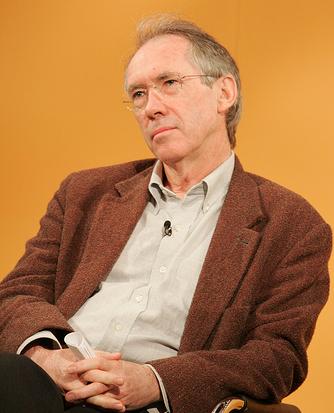
[Image of Ian McEwan credit: Here]

Saturday, 31 October 2009

Eleven by David Llewellyn: Review

Eleven
By David Llewellyn
Published by Seren
Published in 2006

It's another day at work. Uninspired and wondering for the 67th time this week why on earth you are still in this job, you stare with glazed eyes at the emails pinging up on your screen. Mindless chatter, forwarded jokes, yet another blithering email from head office about appropriate use of the lunchroom dishwasher...

This is Martin Davies' life. He's a wannabe screenwriter stuck in a finance office in Cardiff, Wales. It's just another mind-numbing day at the office... except it isn't.

Today is September 11th, 2001.

Eleven is one of many books that have been written about and around the events of September 11th - a growing genre of literature called "Post 9/11 literature" about which I am writing my Masters thesis next year. Overall, this was an interesting book, the most unique thing about it being the way it is written. The narrative is presented through the emails that are coming into Martin's inbox as well as his replies. His thoughts are drafts that are saved but never sent. The placement of the events of another ordinary day against the backdrop of the unravelling of the one of the most historically significant events in recent history serves as a poignant reminder to all who remember this day just how it felt and "where were you when".

The atmosphere of this novel is ultimately depressing as we observe Martin's sanity unravelling thread by thread. It's unclear whether this unravelling is triggered by the events of 9/11 but I'd say it was safe to assume it is. Obvious other contributing factors include his failed relationship, his loathing of his job and position in life but this event seems to tip the balance. The novel ends ambiguously, and kind of unsatisfactorily. There isn't the typical crisis and resolution - 9/11 happens but nobody seems knows what it means or how to react to it. Then again - those who lived through that day know that this is pretty much exactly how it was all over the world: people staring at the TV in astonishment, completely lost for words.

I'm not sure if this will be useful for my thesis, but it was an interesting and quick read. As a representation of the events of 9/11 I think it does very well to capture the confusion and disbelief everyone felt. It doesn't pretend to have anything meaningful to say about what happened or try to explain it. It simply offers a snapshot of the day, from the other side of the globe, through the eyes of Joe Normal. A slice of history, happening in your inbox.

Tuesday, 27 October 2009

Some of my favourite sentences: Part IV

This nugget of wisdom comes from Jess Walter's novel The Zero, one of the post 9/11 novels I'm reading for my thesis.

"No kid ever choses to have his parents. They're just there when you wake up one day. And you can't just keep having sex and have more parents if these two don't work out."

Ah, ain't that the truth!

Saturday, 8 August 2009

Now THAT is impressive...


I was listening to a podcast that I have recently discovered, Books on the Nightstand, this morning when something they were discussing piqued my attention. A British lady named Louise Brown, a 91 year old pensioner, has made newspapers for the extraordinary achievement of borrowing and reading nearly 25,000 library books in her lifetime to date. She takes out 12 a week. A week! She's nearly exhausted her local library's collection of large print books! What a legend.

Suddenly my reading load seemed piffly by comparison and I started to wonder why. I mean, I love reading. I adore books. You may have noticed this very subtle fact from the content of my blog and if you know me personally you surely know me to be addicted to the printed word.

I concluded, after some reflection, that I just don't dedicate as much time as I should to reading (and by "should" I mean "want to"). I used to spend hours and hours reading as a kid but then, as I got older and invariably busier, I realise that reading has slipped down my priorities list without me noticing. I just haven't set aside the time I would like to for it. A big distraction for me has been the internet - Facebook, reading news articles, catching up on emails and googling random questions that pop into my head (like why do people yell "Geronimo!!" when they jump out of a plane?) All well and good, really but it has seriously cut into my beloved reading time.

So! I'm taking action. My challenge to myself is to use the internet less and do a bit more reading and try and get back into the habit of reaching for my books first when I have some spare time rather than turning on the laptop. I'm nearly two thirds of the way through Falling Man by Don DeLillo and hope to finish that by tomorrow or early next week and then I'll probably be working on another post 9/11 book (the thesis looms after all!) which is exciting.

So to all my dear books, I know I've been a bit remiss of late and not picked you up as often as I could have but I'm a reformed woman. And you have Louise Brown to thank for that!

Friday, 14 November 2008

Phantom, Research Day Out and Thesis...

I went to see the Phantom of the opera last night - something I had wanted to do for years and years and years. Literally. I love the music, I love the drama and culture surrounding an international stage performance... it's an energy that makes me feel more fully alive. Like I'm experiencing something worthwhile, something which will be noted in the memory banks as a Night To Remember for years to come. It was an incredibly fulfilling experience... and also part of a "self care" thing I'm working on. After years of hearing the words "No" and "Can't" it's hard to switch yourself into "Yes" and "Can" mode.

And now for something completely different... We had a Research Day Out at work today. Normally, work doesn't figure much on my blog, not because I don't like it - I do - I love it in fact. However I guess it's not really what I want to be rambling on about in my spare time. But today was different - 12 different grad students from both Massey and Waikato came together to present on their Masters/PhD research and the result was nothing short of stunning. From work engagement in aid organisations, to androgen's effect on adult gender identities, to homelessness, to emergency management, to the lived experiences of heavy metal fans, to resilience in migrant communities... we really had it all. THIS was the answer to the question I get asked so very often in my job: "What can I do with Psychology?" The answer, obviously, is just about anything you like!
The thing that really captured my attention and imagination though was one section of Darrin Hodgett's presentation which spoke about the homelessness project which he's involved in with Kerry Chamberlain from Massey. They found that a key space that homeless people engage with other in is the public library - here they have a place to be where they can read, engage with others, research things that interest them and get off the streets for a while. This really caught me as I too absolutely love public libraries. Just going ito one has an incredibly calming effect on me - a function of me being a total literophile I'm sure - something I have found from an early age. Nothing, but nothing will make me quite as happy in quite the same way as putting me amongst a bunch of books. And to find that others could also garner similar feelings from libraries was interesting - although no doubt the element of social engagement is more pertinent to those who are homeless. I also loved how this smashed any stereotype that may hang around about homeless people all being uneducated bums.

Speaking of education - the continuing of mine is rolling along nicely. I had some email correspondence with the person I have wanted to be my thesis supervisor since undergrad days about my ideas for my upcoming MA thesis. I'm thinking something in the area of post 9/11 literature and the domestic, I think. I'm just going to read as widely as I can at this stage and roll out from there. It's very exciting. Of anyone happens to be reading this and knows of something (anything) related to post 9/11 literature, please let me know. Cheers!

Sunday, 9 November 2008

Book Review: Relative Strangers by Emma Neale

Ever since the collapse of the Twin Towers in New York on 9/11, 2001 there has been an ever increasing body of literature which has come to be referred to as "Post 9/11 Literature". Although my investigations into this field have only been cursory so far, it has captured my attention. As part of a wider field of trauma literature, post 9/11 literature deals with the Western world's processing and making sense of the atrocities of this day.

The majority of critical attention paid to post9/11 literature has been focused on American literary responses, however when I read Relative Strangers by Emma Neale, a NZ novel, it seemed to me to fit this field.

Relative Strangers starts with Chloe being found in Colin's lounge. She has wandered in there in a state of shock after a series of traumatic events have unfolded in her life. Colin, whom she has never met before, comes home to find this strange and bedraggled woman with her infant son, sat on his couch looking through his personal effects. This the story begins as the reader unravels the narratives of both Chloe and Colin. Coming together under unusual circumstances they find solace in each other - each are survivors of their own particular tragedies - and begin to work through their respective traumas. The glue in this pseudo domestic arrangement is Toby, Chloe's son. The privileging of the domestic and parenthood in this novel appears to be typical of post 9/11 literature - possibly the retreat into the comforting and familiar in the face of death and terror - and is seen as the avenue to healing of both the personal traumas of the protagonists and also the collective trauma of the post 9/11 world.

I thoroughly enjoyed this novel, Neale's prose is a delight to read - one of my favourite sentences was garnered from this book - and the positioning of New Zealand in the fall out from the 9/11 proves that although our little country may seem remote we are as connected to, and affected by, world events as anywhere else in the world.

I give this a book a solid 8/10.

Sunday, 19 October 2008

Madness


I have been vastly remiss of late in my posting on here but the reason is that all of my writing energy has been going into my end of year assignments and other such academic pursuits.

However, there is a link - the research essay I am completing (all of the glorious 5000 words of it) will form the basis for the long overdue review I promised for Emma Neale's Relative Strangers. Fear not, though I will condense it considerably before posting it here.

In any case, I just cannot believe that in 10 days, another academic year will be over for me. It's (supposedly) the last time I will ever do paper based study again (but I am still young and extremely geeky, so watch this space!!) and it's all a little odd. And I don't really have the time to sit and savour it, even a little, as I'm just so head down, bum up in the middle of it all. It is utter madness, I tell you.

Having said that, I wouldn't have it any other way.